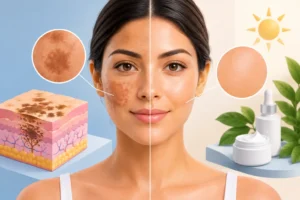

A new cluster of brown spots across the cheeks, a patchy forehead that will not brighten, or skin that suddenly looks rougher in certain light – these are common reasons people seek sun damage treatment. The right approach is rarely one treatment performed once. It is a considered plan that identifies what is happening in your skin, treats it safely, and helps prevent the pigmentation returning.
Sun exposure is cumulative. Even when the burn was years ago, UV exposure can leave visible changes in pigment, texture, fine lines and small blood vessels. The good news is that many of these concerns can improve with professional treatment and consistent home care. The honest part is that results depend on the type of damage, your skin tone, your lifestyle and how reliably you protect your skin afterwards.
What does sun damage look like?
Sun damage does not always look like a dramatic sunspot. It may show up as freckles that have become darker or more numerous, flat brown age spots, uneven skin tone, redness, enlarged-looking pores, fine lines or a coarse texture. On the chest, shoulders and hands, it can appear as scattered brown patches that make the skin look older than it feels.
Not all pigmentation is the same. Solar lentigines, often called age spots, tend to be clearly defined brown marks caused by accumulated UV exposure. Freckles commonly deepen in summer and fade somewhat in lower-UV months. Melasma is more complex: it often presents as symmetrical, cloudy patches on the cheeks, forehead or upper lip, and can be influenced by heat, hormones, visible light and irritation as well as sunlight.
This distinction matters. A treatment that works beautifully for a discrete sunspot may not be the best first choice for active melasma. Treating every brown mark in the same way can lead to disappointment or, in some skin types, post-inflammatory hyperpigmentation.
Why a personalised sun damage treatment plan matters
Before recommending a procedure, a good practitioner will look at the colour, depth and pattern of pigmentation, as well as your Fitzpatrick skin type, medical history, current skincare and recent sun exposure. They should also ask whether the marks have changed, itched, bled or developed an irregular border.
Any spot that is new, changing or concerning needs medical assessment before cosmetic treatment. Aesthetic treatments are designed to improve benign pigment concerns, not to diagnose skin cancer.
At Beautilase, consultation is where the plan begins. For some clients, the safest route is to prepare the skin with targeted skincare before any in-clinic procedure. For others, a focused pigmentation laser treatment or medical-grade peel is appropriate. Patch testing may be recommended, particularly for deeper skin tones or skin with a history of reacting to treatments.
Professional options for sun-damaged skin
Laser treatment for age spots and freckles
Laser pigmentation removal uses controlled light energy to target excess melanin in specific areas. It can be an effective option for well-defined sunspots and freckles, particularly when the surrounding skin is otherwise healthy. After treatment, pigment may temporarily darken before it flakes or fades – this is often part of the normal process.
Laser is not automatically the best answer for diffuse pigmentation or melasma. Heat can aggravate melasma in some people, so treatment must be selected carefully. Your practitioner may advise a different modality, a gentler programme, or a period of skin preparation first.
Medical-grade chemical peels
Professional peels help lift surface pigmentation and encourage cell turnover, improving dullness, uneven tone and rough texture. Their depth and ingredients should be chosen according to the concern and the resilience of your skin. A series of lighter peels can be a sensible, lower-downtime option, while stronger peels may be suitable for selected clients.
Peels do involve a trade-off. Mild flaking and temporary sensitivity are common, and your skin must be protected carefully while it recovers. Trying to accelerate the result with exfoliating acids, scrubs or active products at home can create irritation and make pigmentation worse.
Dermamelan and Cosmelan programmes
For stubborn melasma and widespread hyperpigmentation, a structured depigmentation programme such as Dermamelan or Cosmelan may be more appropriate than treating individual spots. These programmes combine a professional in-clinic mask with a prescribed home-care routine to interrupt excess pigment production over time.
Commitment matters here. Visible improvement can be significant, but maintenance is essential because melasma has a tendency to recur. Your practitioner will guide you through the initial recovery period, when redness, dryness or peeling may occur, and adjust your home routine as your skin settles.
RF microneedling for texture and early ageing
When sun damage includes crepey texture, fine lines, enlarged pores or acne scarring alongside uneven tone, RF microneedling may form part of a broader plan. The treatment combines microneedling with radiofrequency energy to support collagen remodelling deeper in the skin.
It is not a direct replacement for pigment-targeting laser treatment. However, it can be valuable when the goal is healthier-looking skin overall, not simply a lighter brown spot. Many clients benefit most from treating pigmentation and texture in stages rather than asking one procedure to solve every concern.
The skincare that protects your results
Professional treatment can correct visible damage, but daily habits determine how well those results hold. Broad-spectrum SPF 50+ should be the non-negotiable foundation, applied generously every morning and reapplied when you are outdoors, driving for long periods, exercising or sitting near strong daylight.
For pigmentation-prone skin, tinted sunscreen can be particularly useful because iron oxides may help protect against visible light, which can aggravate melasma. A wide-brimmed hat, sunglasses and shade add another practical layer of protection. This is not about avoiding the outdoors; it is about giving your skin a fair chance to recover.
Your home routine may also include ingredients chosen for your tolerance and concern, such as vitamin C, retinoids, pigment-regulating actives or barrier-supporting moisturisers. More products do not necessarily create better results. Irritated skin is more likely to develop uneven pigmentation, so a simple routine used consistently often outperforms an overloaded shelf.
What results and downtime should you expect?
Sun damage treatment is best viewed as a process, not a quick fix before an event. Some age spots respond after one or two laser sessions, while diffuse pigmentation and melasma usually require a longer programme and ongoing maintenance. Texture changes from collagen-stimulating treatments develop gradually over the following weeks and months.
Downtime also varies. A focused pigment laser session may leave treated spots looking darker for several days. Peels can cause light to moderate peeling, and RF microneedling can bring temporary redness and warmth. Your treatment timing should take account of holidays, major events and any unavoidable sun exposure.
Be wary of promises to remove all pigmentation permanently. Skin continues to respond to hormones, heat, inflammation and UV exposure. A candid plan aims for clearer, more even skin and gives you realistic tools to maintain it.
When to book a consultation
If brown spots are multiplying, your foundation no longer sits evenly, or you are unsure whether your concern is sun damage, melasma or something else, a professional assessment can save time and unnecessary treatments. Bring the skincare products you currently use and be open about past procedures, medication and upcoming travel. These details help make your plan safer and more effective.
The most satisfying results tend to come from a calm, consistent approach: treat the concern in front of you, respect how your skin responds, and protect the progress you have made every day.